Contents 11
What was included in the Shopify store build
A turnkey Shopify store build is the coordinated setup of the commercial offer, storefront, catalogue, fulfilment, payments, trust content, search foundations, and launch checks. Tuckora is a useful example because the work did not stop at installing a theme. Every layer had to agree with the next one: the product promise with the supplier variant, the product page with the checkout, and the advertising creative with what the customer could actually buy.
The live store is available at Tuckora. The concise portfolio version is published as the Tuckora Shopify development case; this article documents the implementation decisions in more detail.
The scope covered:
- product and market research for the US launch;
- positioning and information architecture for a narrow bed-making
brand; - redesign of the home, collection, product, cart, guide, and policy surfaces;
- four distinct product offers with unique titles, descriptions, metadata, media, and FAQs;
- DSers variant mapping and Shopify Bundles logic;
- Stripe Card Payments and PayPal through Western Bid and WB Connector Neo;
- shipping, customs, return, and merchant-of-record notices where the customer needs them;
- technical SEO/GEO basics and internal linking;
- desktop and mobile QA;
- two edited advertising concepts in three placements each.
From 25 product hypotheses to one coherent store
The project started before visual design. Twenty-five product ideas were compared by buyer problem, competition, shipping complexity, supplier reliability, demonstration potential, and the chance to build a coherent range. A store that sells unrelated dropshipping items can be launched quickly, but it is hard to explain and even harder to trust.
The selected direction was a compact bed-making system. The range contains a mattress lifter, fitted-sheet straps, and bundles that combine those components. That choice gave the brand one understandable promise without pretending that every bedroom problem has the same solution.
Live search evidence also shaped the language. A SerpAPI snapshot on 8 August 2026 showed that English search results separate three intents: Shopify development agency, Shopify store setup service, and Shopify store development case study. It also showed that turnkey Shopify store is heavily mixed with prebuilt dropshipping stores. For this reason, the English article uses development and setup language, while the portfolio page targets the case-study intent. Search volume and keyword difficulty were not available from this source and are not presented as measured values.
Redesign around the buyer's next decision
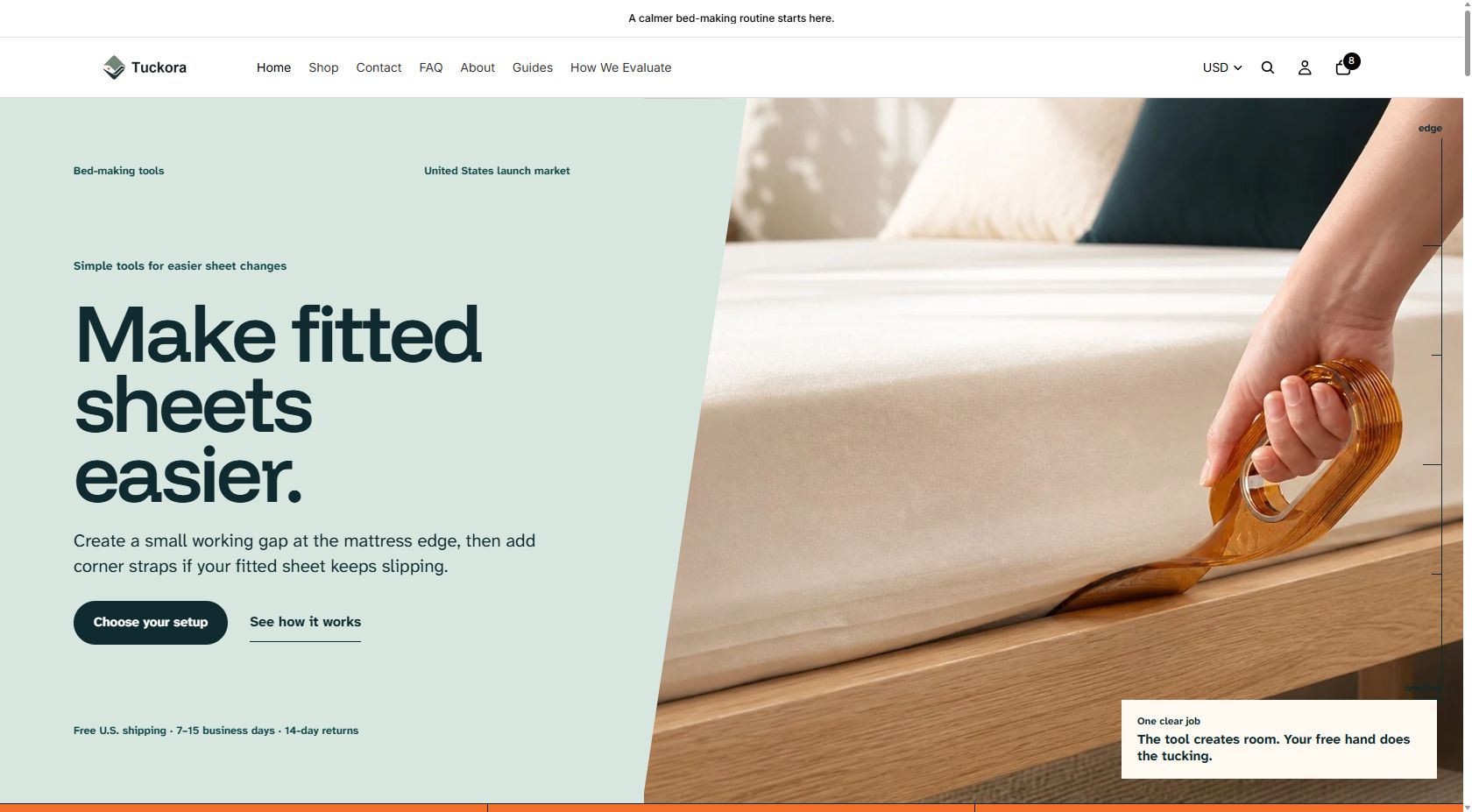
The first version looked like a generic one-product storefront. The redesign changed the page sequence, not only its colours. The home page starts with the bed-making problem and shows the tool in context. The collection page compares the four offers by task. Routine Builder helps a visitor choose between creating space at the mattress edge, securing sheet corners, or buying a combined kit.
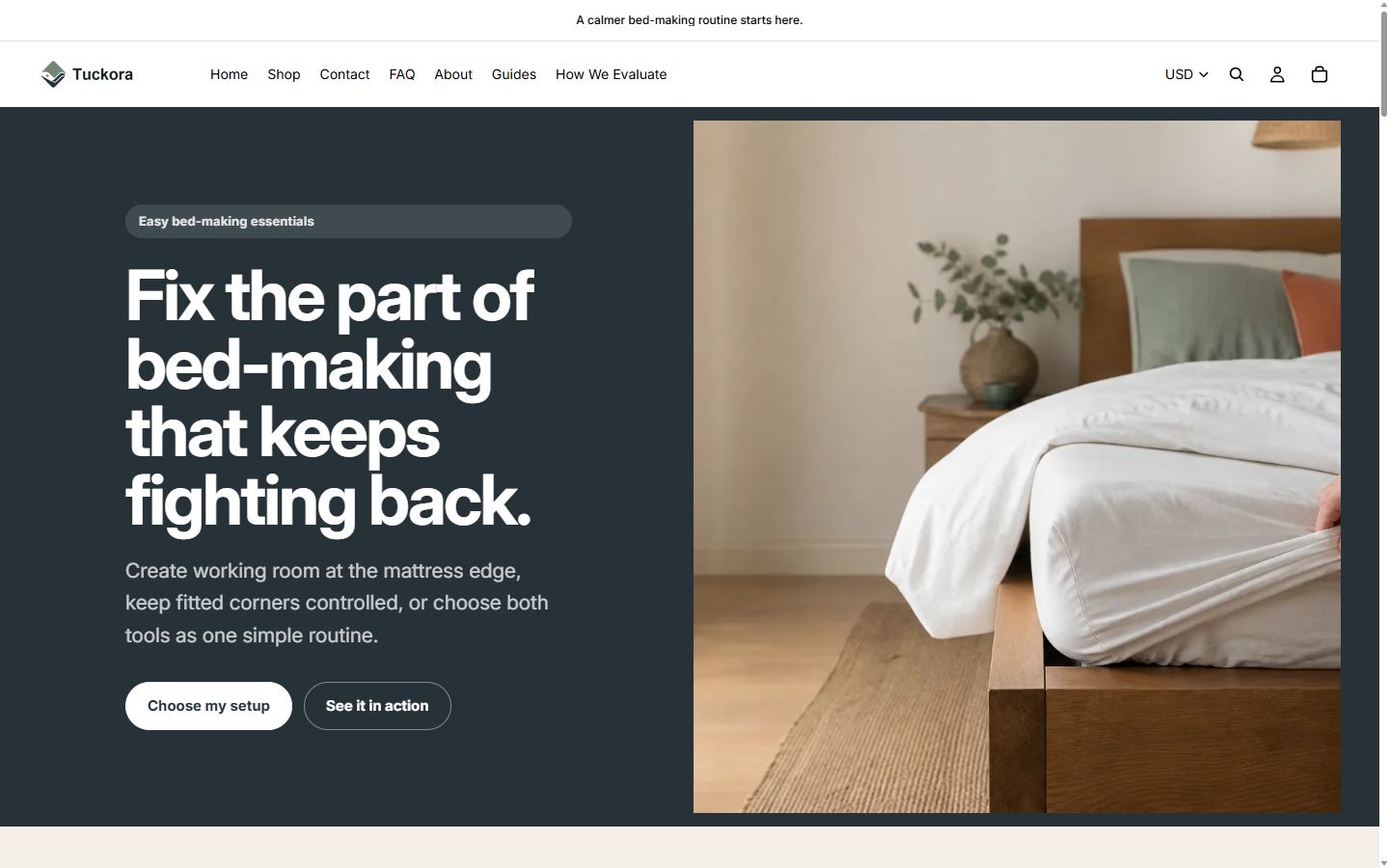
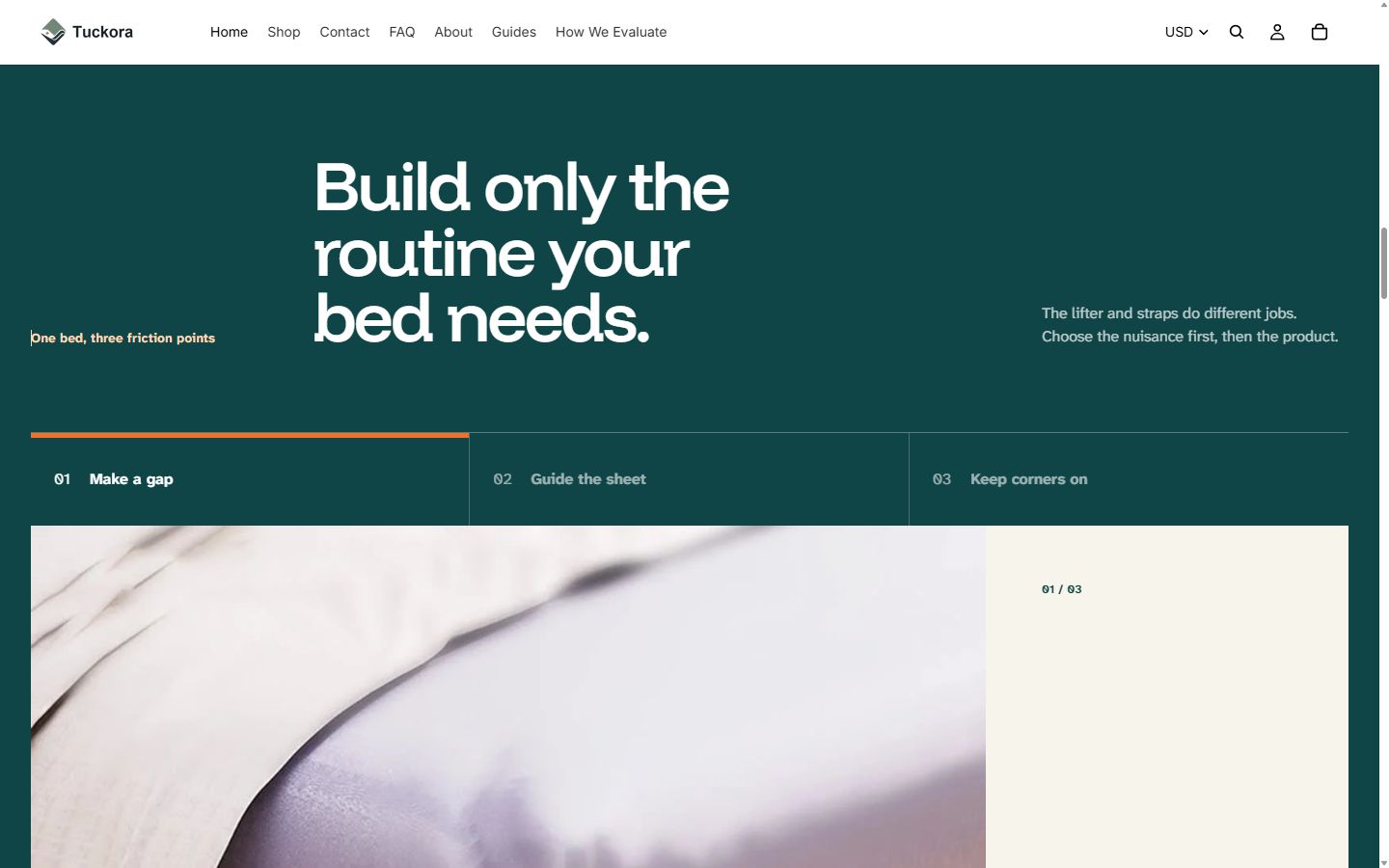
This structure matters for both conversion and search. A visitor can understand the difference between products without opening every card, while search and AI systems receive clearer entities, use cases, and internal relationships.
Product pages rebuilt as decision pages
Each offer received its own title, meta description, product copy, image sequence, and FAQ. Product pages now answer five questions before asking for the order:
- What job does this product do?
- Which bed and routine does it fit?
- What does it not do?
- What exactly is included?
- What happens after the customer pays?
The pages include a quick answer, factual summary, use cases, limitations, step-by-step instructions, specifications, shipping and return information, and three visible FAQs. The gallery supports thumbnails, video, a full-size lightbox, keyboard Escape, and mobile interaction. Variant selection updates the relevant media, and the add-to-cart area shows a quantity-aware total.
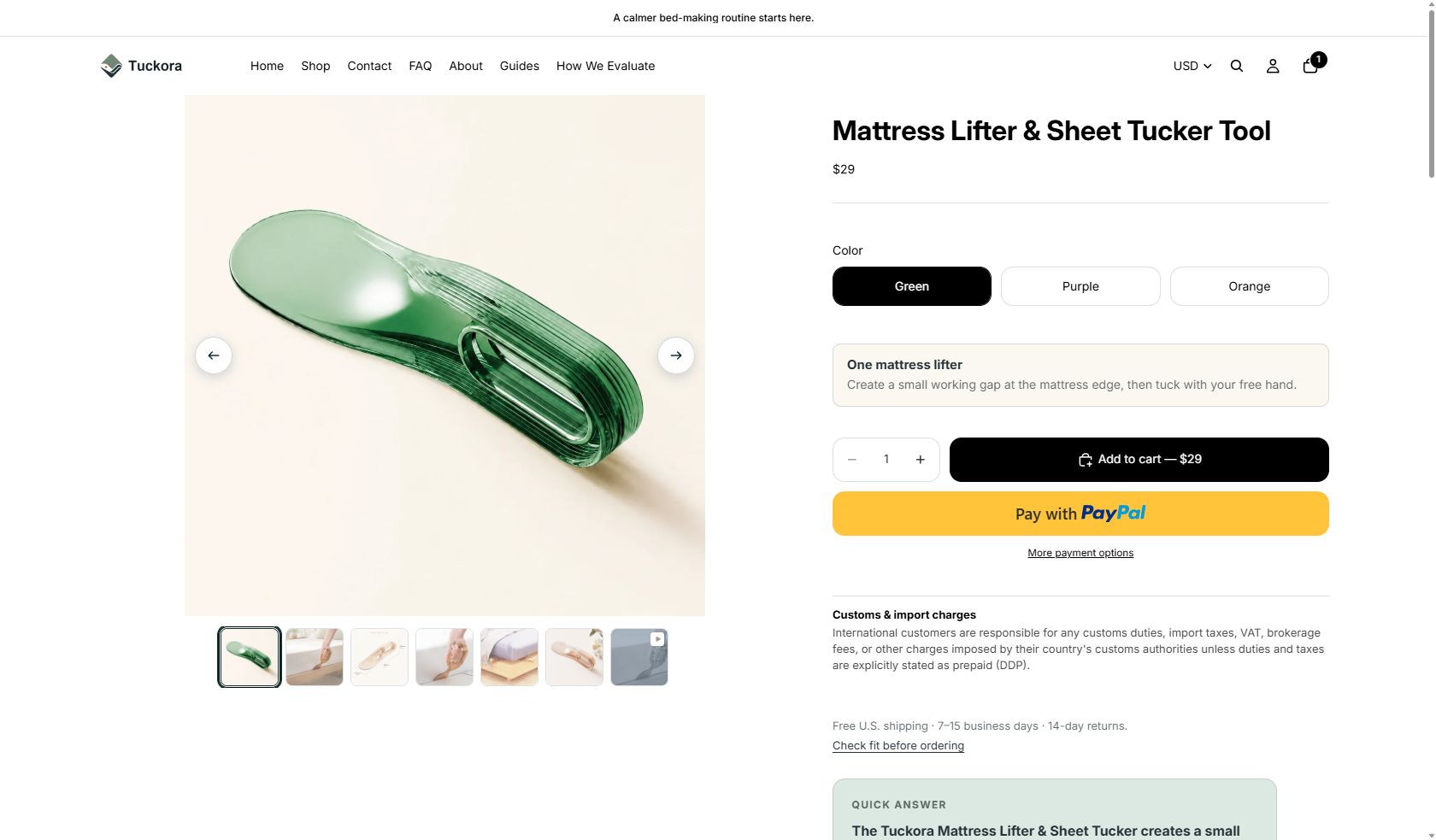
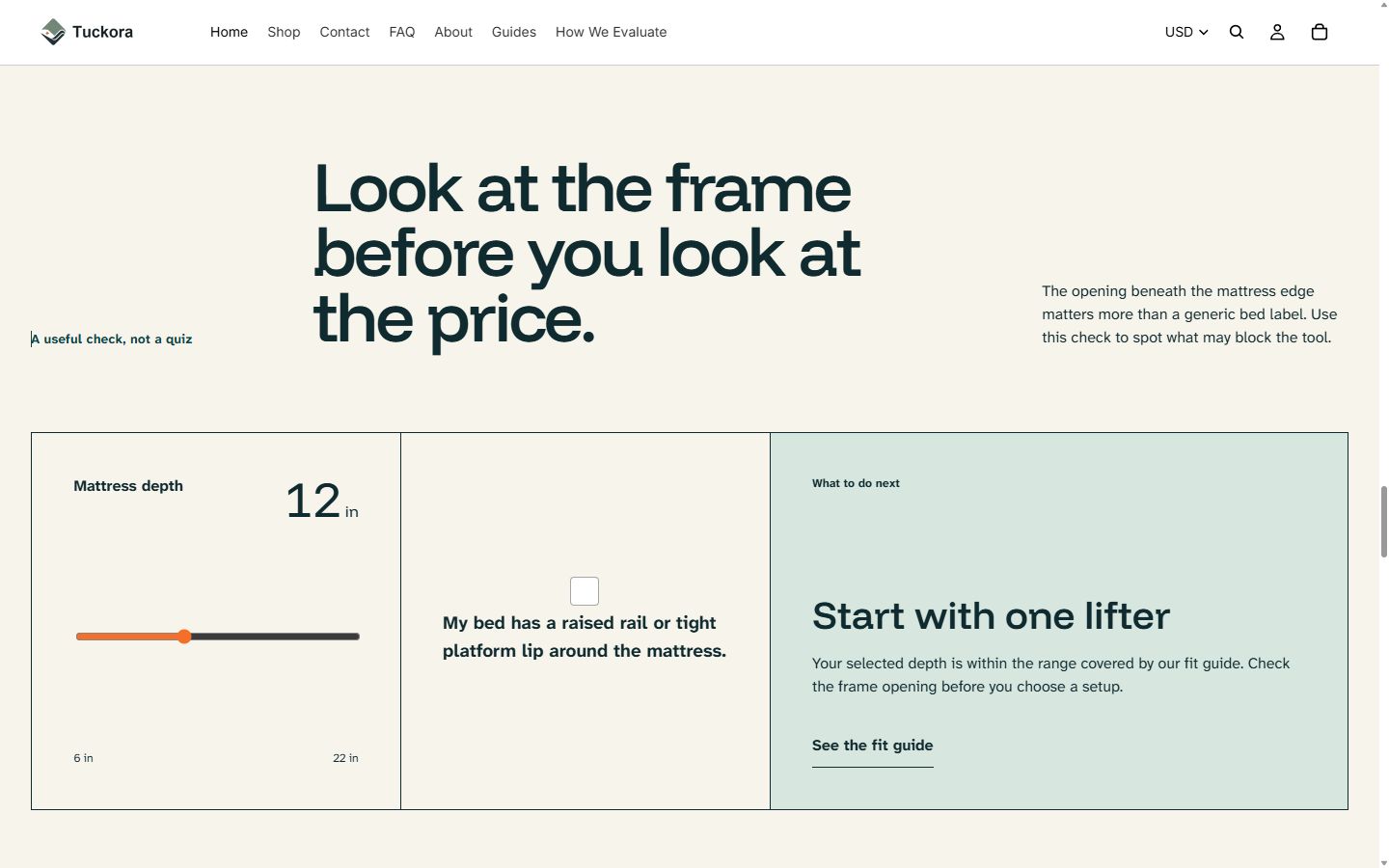
The fit checker was added to prevent the wrong expectation. A mattress lifter creates temporary working space at the mattress edge; it is not a medical lifting device and does not lift a person. Stating this limit is better product communication and a stronger trust signal than a universal benefit claim.
DSers and bundles: the hidden operational layer
Connecting DSers is not complete when an app badge appears in Shopify Admin. The customer-facing variant must point to the correct supplier variant, quantity, and product. In Tuckora, the Green, Purple, and Orange lifter options were mapped one-to-one. The straps offer maps to the supplier's 4pcs Black variant with quantity one. Supplier-only axes remain hidden from the storefront.
Bundle logic required a second layer. Shopify Bundles decomposes a kit into the actual components, and DSers fulfils the supplier items. This reduces the risk that a bundle title looks correct to the customer while the wrong item reaches the supplier order.
The implementation has a stated boundary: no paid automated inventory synchronisation is claimed. A manual inventory cap and operating guardrail are used instead. A final paid order-level fulfilment test is still required before the fulfilment chain can be called fully accepted.
Stripe and PayPal through Western Bid
For this operating model, payments were connected through Western Bid. Stripe Card Payments and PayPal were activated on 6 August 2026, and WB Connector Neo was installed in Shopify. The public US checkout displays card payment, PayPal, and Google Pay where eligible.
Payment setup also changed the content layer. Merchant-of-record wording, terms, and customs notices were placed on product and cart surfaces so that the buyer sees material conditions before payment, not after a dispute.
The verified state is activation and public checkout visibility. The remaining acceptance gates are a live paid charge, settlement reconciliation, refund test, and a complete order-to-supplier fulfilment check. No revenue, conversion rate, CAC, or ROAS is inferred from configuration work.
Advertising video from supplier footage
The supplier footage was used only after its usage rights were recorded. We selected demonstrations that matched the real offer, edited two concepts, wrote scripts, added captions, and generated voiceover with ElevenLabs Sarah using the multilingual v2 model. Each concept was prepared in three placements, producing six delivery-ready files.
The videos were uploaded to Meta, but the advertising account was restricted before campaigns could deliver. Therefore the work is described as creative production and launch preparation, not as a media-performance result.
SEO and GEO foundations
Shopify provides useful defaults, but a new store still needs deliberate page roles. Tuckora received unique product metadata, descriptive internal links, visible FAQs, Product structured-data checks, canonical and sitemap review, image alt text, and a content path from problem to offer. The public pages were checked on desktop and mobile.
For GEO, the important part is not adding AI vocabulary. It is making key facts extractable and consistent: what the product is, who it fits, what is included, what its limits are, how payments work, and which validation gates remain open. The same facts are kept consistent across product copy, FAQs, policy notices, and structured data.
What is complete and what remains to be tested
| Workstream | Verified state | Remaining gate |
|---|---|---|
| Storefront and catalogue | Live home, collection, product, guide, cart, and policy surfaces | Continue post-launch usability review |
| Product content | Four distinct offers with fit, limits, instructions, specs, shipping, returns, and FAQs | Update only when product or supplier facts change |
| DSers | Variant mapping configured and reviewed | One final paid order-level fulfilment test |
| Payments | Stripe Card Payments and PayPal activated through Western Bid; methods visible at checkout | Live charge, settlement, and refund test |
| Advertising creative | Two concepts, six placement-ready files, captions, ElevenLabs voiceover | Media delivery and performance validation |
| SEO/GEO | Metadata, internal links, FAQ and product facts reviewed | Measure indexed queries and qualified organic traffic after enough data accumulates |
Frequently asked questions
What does a turnkey Shopify store setup include?
It should include more than theme installation. The minimum useful scope combines offer architecture, storefront design, product and collection pages, navigation, payments, shipping and policy content, fulfilment mapping, analytics readiness, SEO foundations, responsive QA, and a documented launch checklist. The exact set depends on the business model and markets.
Can DSers setup be included in Shopify development?
Yes, when the store uses a supplier through DSers. Each visible Shopify variant must be mapped to the correct supplier variant and quantity. Bundles, inventory policy, hidden supplier options, and at least one controlled order-level test also need review. Installing the app alone does not verify fulfilment.
How were Stripe and PayPal connected for Tuckora?
Stripe Card Payments and PayPal were activated through Western Bid, with WB Connector Neo installed in Shopify. The methods are visible in the public checkout. A full payment acceptance test still includes a paid charge, settlement reconciliation, refund, and verification that the Shopify order state matches the provider state.
Does a custom Tuckora storefront require Shopify Plus?
No. Tuckora runs on Shopify Basic. Custom home, collection, product, guide, and cart experiences can be built at theme and app level. Shopify Plus is relevant for a different class of checkout control, automation, and enterprise requirements, not for every custom storefront.
Were advertising results generated by this project?
No advertising outcome is claimed. Two concepts were edited into six placement-ready videos and uploaded to Meta, but the ad account was restricted before delivery. The verified deliverable is the creative package, not spend, sales, CAC, or ROAS.
What should be tested before launching paid traffic?
Test the mobile purchase path, variants, quantity totals, cart, checkout methods, policy notices, analytics events, a paid charge, refund, and the fulfilment route to the correct supplier item. Search pages should also be indexable with consistent canonical, metadata, and structured data.
Where can I see the finished store and the shorter case?
Visit the live Tuckora store and the concise Shopify development case. For a similar implementation, see Shopify store development or request an audit through the UPLIFY contact form.
Sources
- [1]Tuckora live store
- [2]Shopify theme architecture
- [3]Shopify products, variants, descriptions, and media
- [4]Third-party payment providers in Shopify
- [5]PayPal and Stripe for Shopify through Western Bid
- [6]Variant mapping in DSers
- [7]ElevenLabs Text to Speech
- [8]Shopify SEO overview
Discuss your Shopify store
Tell us about your catalog, market and launch goal. We will agree on the scope and budget for your store.