How much does Shopify website development cost, and what is included in a launch?
UPLIFY builds Shopify stores for international sales: we configure the theme, catalog, markets, payments, shipping and analytics, then QA the launch. Three one-time packages cost $1,000, $1,500 and $2,500. We import up to 50, 200 or 500 products from prepared data; Markets + GEO adds category and title work without promising AI visibility.
Shopify store development
for international sales.
We plan the catalog and mobile buying path, configure the theme, Markets, payments and analytics. Your store stays in your Shopify account; before handover, we test the order path and document what is configured and what depends on third parties.
/ tl;dr
Shopify store
scope.json.
[01]price::$1,000
[02]timeline::from 2 weeks
[03]ownership::your Shopify account
[04]analytics::GA4 + Meta Pixel
[05]SEO::structure + indexing
[06]support::14, 21 or 30 days
Shopify. Shopify website development covers catalog structure, theme design, products, localization, payments, shipping, analytics, technical SEO and checkout testing. At launch, the merchant receives account access, working documentation and a defined support period tied to the selected package.
/ fit
When Shopify is the right platform
Shopify is worth considering when a store sells, or plans to sell, beyond one local market. The platform handles much of the hosting and update burden. The project still needs careful decisions about markets, payment providers, tax settings and content ownership.
A DTC brand with its own product
A move from an older platform
For a store selling only in Ukraine and relying on local integrations, Horoshop is often easier to operate. Before quoting, we compare platforms against the target markets, payments, catalog and development plan. Shopify vs Horoshop.
/ workflow
From brief to a tested checkout
The delivery window starts once we have access, catalog data, brand assets and approved content. Each phase ends with a concrete result that can be checked before the next payment milestone.
01 · STEP
Discovery and technical plan
02 · STEP
Structure and theme
03 · STEP
Catalog and content
04 · STEP
Markets, checkout and integrations
05 · STEP
Analytics, SEO and advertising
06 · STEP
QA, launch and handover
/ launch scope
What we configure before launch
The exact scope follows the package, yet the technical baseline is consistent: the store must accept a test order, send essential events to analytics and give search engines coherent crawl and index signals.
Storefront and UX
Catalog
Markets
Checkout
Measurement
SEO and GEO
/ Two public Shopify stores
Two Shopify projects: from product hypothesis to public launch
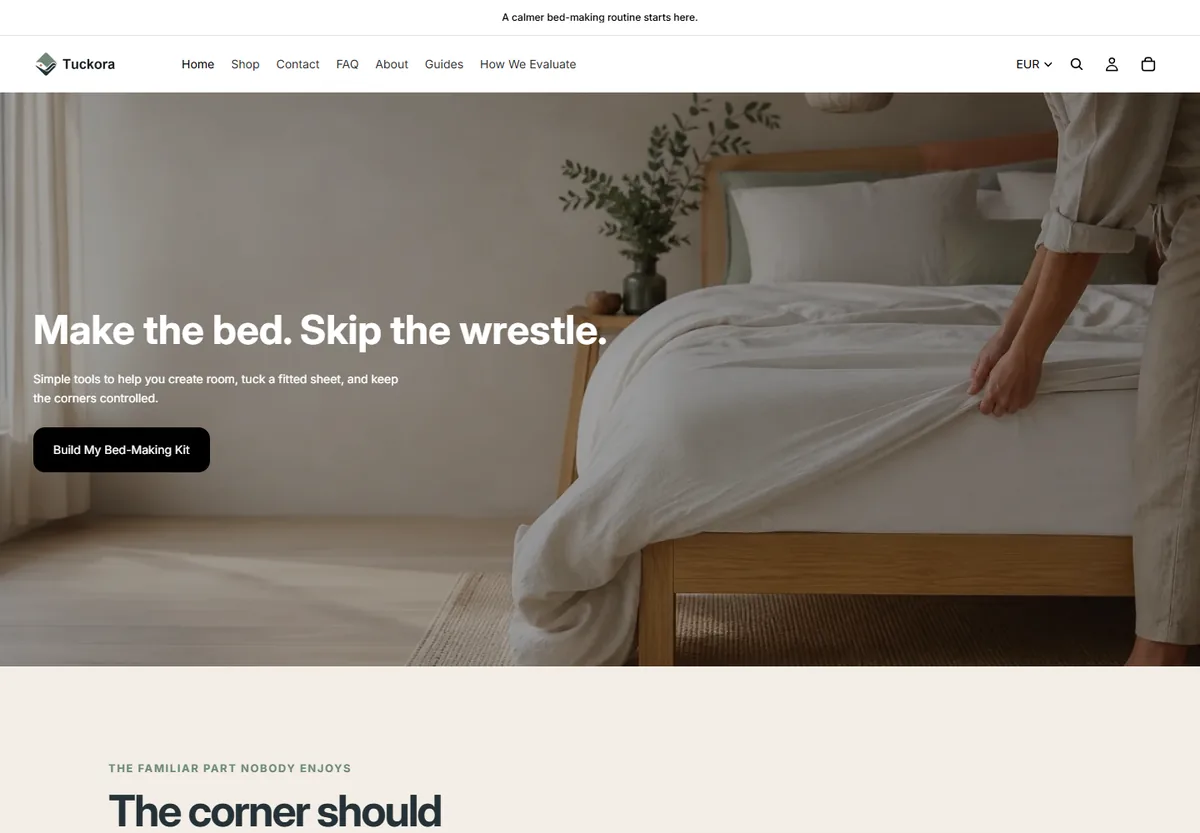
- 25 product hypotheses reviewed; four offers released in the live catalogue
- DSers mapping and Shopify Bundles configured for the agreed products
- Stripe Card Payments and PayPal activated through Western Bid
- Two video concepts prepared for six advertising placements
The public storefront was available on 24 September 2026; purchase availability depends on the selected market (the US is the launch market). Live charge, refund and paid-order fulfilment remain separate checks. No sales or ROAS is claimed.
Open Tuckora Home ↗Read the full Tuckora case →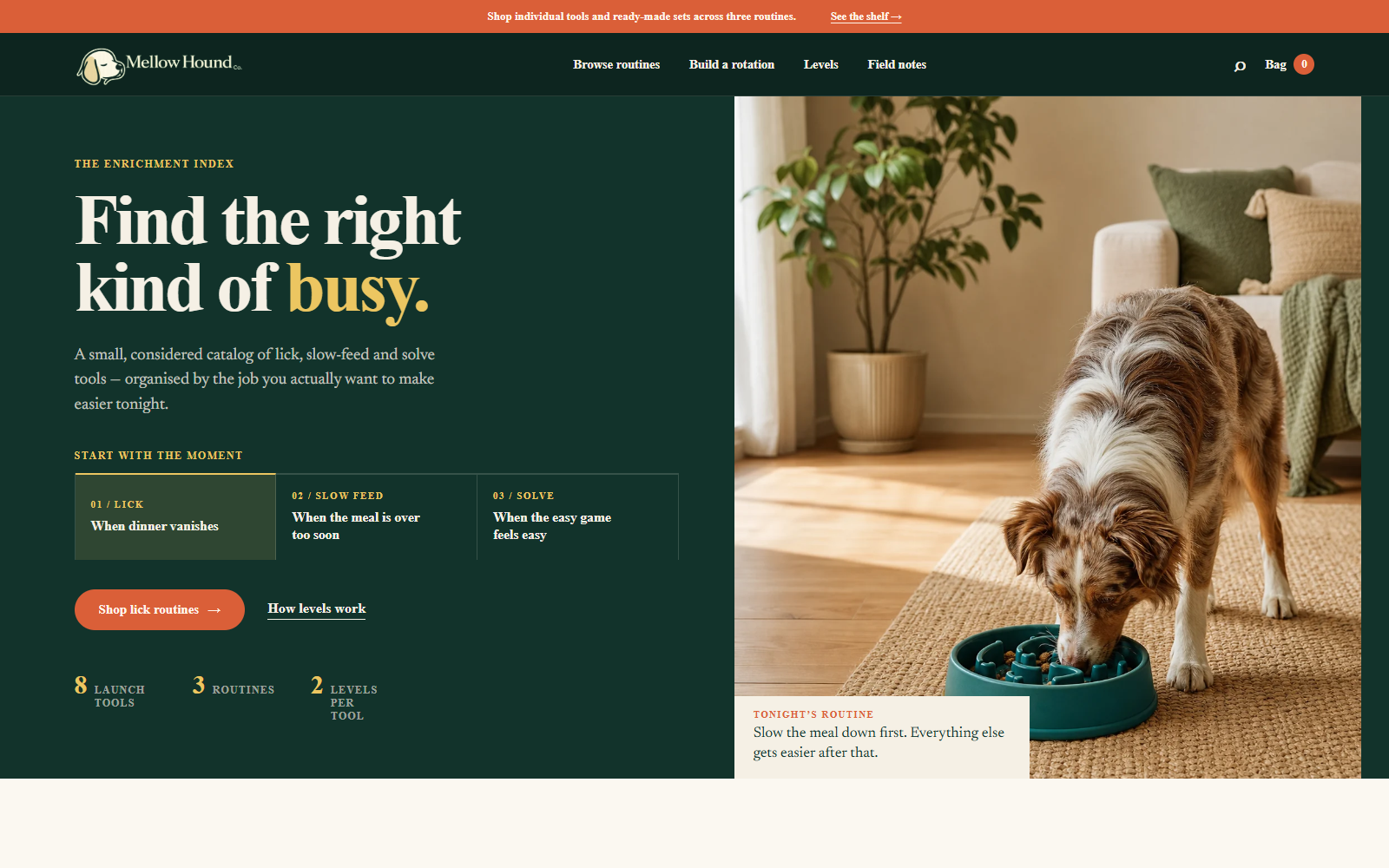
- At launch: 8 products and 10 verified variants; the catalog has since expanded
- Three buyer routines: Lick, Slow feed, and Solve
- A custom rotation builder connected to the cart state
- Domain, SSL, mobile QA, and release checks completed
The public store and product catalog were available on 24 September 2026. This confirms delivered work, not sales, rankings or ROAS.
Open Mellow Hound ↗ Read the full Mellow Hound case →/ pricing
Packages with clear boundaries
Three packages for launching on an existing theme. Product counts describe the included preparation and import from structured source data, not a Shopify platform limit. We confirm price and timing after reviewing the catalog, markets, payments and third-party integrations.
01 · START
Start
up to 50 products · 1 market · 2–3 weeks
best fit
scope
up to 50 products · 1 market
timeline
2–3 weeks
when to choose it
A first store with a ready brand and structured catalog.
$1,000one-off
Shopify plan, theme, apps and third party licenses are paid separately
What is included
- Official theme and 5 core page templates
- Up to 50 products from prepared source data
- 1 market and 1 language
- Setup of eligible payments and shipping
- GA4, Meta Pixel, Search Console and baseline SEO
- Test order, handover and 14 days of support
recommended
02 · GROWTH
Growth
up to 200 products · ad-ready · 3–4 weeks
best fit
scope
up to 200 products · 1 market
timeline
3–4 weeks
when to choose it
A brand with a larger catalog preparing for paid acquisition.
$1,500one-off
Shopify plan, theme, apps and third party licenses are paid separately
What is included
- Everything in Start
- Up to 200 products from a structured CSV
- Up to 2 adaptations of existing-theme sections
- GA4 ecommerce-event and ad-catalog checks
- Merchant Center feed check and Microsoft Clarity
- 2 revision rounds and 21 days of support
03 · MARKETS + GEO
Markets + GEO
up to 500 products · 2 markets · 4–6 weeks
best fit
scope
up to 500 products · 2 markets
timeline
4–6 weeks
when to choose it
A two-market launch with category architecture and SEO/GEO preparation.
$2,500one-off
Shopify plan, theme, apps and third party licenses are paid separately
What is included
- Everything in Growth; up to 500 products from structured data
- Up to 2 markets and 2 languages with supplied translations
- Batch title normalization using verified attributes
- Up to 15 categories: structure and editorially reviewed AI drafts
- Manual QA for up to 20 key product pages, feed and markup
- 2 revision rounds and 30 days of support
You provide accurate prices, variants, images, attributes and content rights. AI helps normalize titles and draft copy, but we do not invent product facts. Writing 500 unique descriptions by hand, complex migration, ERP and custom themes are scoped separately.
/ commercial terms
Terms that protect the timeline and budget
Paid separately
Payment schedule
When the timeline starts
Revisions and scope changes
Policies and payments
Support after launch
/ platform choice
Shopify, Horoshop or WooCommerce
Criterion
Shopify
Horoshop
WooCommerce
Best fit
International DTC across several markets
Sales in Ukraine with local integrations
A content led store with its own technical team
Infrastructure
Managed by Shopify
Managed by Horoshop
Managed by the owner or contractor
Daily maintenance
Theme, apps, catalog and markets
Catalog, content and local modules
Hosting, security, plugins and backups
Main tradeoff
Recurring fees and dependence on the app ecosystem
Less flexibility for complex international DTC
More responsibility for technical health
/ methodology
Sources and review date
/ faq
Questions before kickoff
01How much does a Shopify store cost to build?
Start costs $1,000, Growth $1,500 and Markets + GEO $2,500 as one-time projects. They cover preparation and import of up to 50, 200 or 500 products from structured source data. Shopify subscription, domain, paid theme, apps, provider fees and third-party licenses are separate.
02How long does Shopify website development take?
Start usually takes 2–3 weeks, Growth 3–4 weeks and Markets + GEO 4–6 weeks. Timing starts after deposit and receipt of access, prepared catalog, brand assets and selling rules. Complex integrations or migration are quoted separately.
03Are translation and product entry included?
We import the agreed volume from a prepared structured catalog. Markets + GEO normalizes titles in batches using verified attributes, prepares up to 15 priority categories with editorial review of AI drafts and manually checks up to 20 key product pages. Full translation and individually writing hundreds of descriptions are excluded.
04Can you migrate a store from another platform?
Yes, but migration is not included in the fixed packages. We first inspect product exports, variants, images, customer data and live URLs, then quote the migration and redirect plan separately. We do not guarantee preservation of Google rankings.
05Which payment methods can Shopify support?
Provider availability depends on the merchant's registration country, bank, currency and KYC requirements. During discovery, we check the available routes. The merchant opens and verifies the payment account. Shopify Payments should not be assumed to work in every country, so this decision is recorded before checkout development.
06What do you test before launch?
We place test orders and check mobile and desktop journeys, cart, discounts, shipping, tax, email and the payment path. GA4, Meta Pixel, canonicals, robots, sitemap, metadata, redirects and access to priority pages are reviewed separately. The store opens only after written client approval.
07Will the store be ready for Google Ads and Meta Ads?
Start includes GA4, Meta Pixel and Search Console. Growth adds ecommerce-event checks and catalog preparation for ad channels. Markets + GEO also checks the feed and priority category structure. Merchant Center, ad-account and product approvals are platform decisions, not package guarantees.
Reviewed by the UPLIFY team on 24 September 2026
let’s plan your Shopify store
for your markets.
Tell us what you sell, which countries you target and whether the catalog is ready. We reply within one business day, scope the work and prepare an estimate after the brief.
-
01/03
Request
Form or Telegram. We reply the same business day.
-
02/03
Call or message
Brief: catalog, markets, languages, payments and integrations.
-
03/03
Plan and estimate
We agree on the package, dependencies, indicative timeline and separate Shopify and app costs.