Meta Pixel only
- iOS 14.5+ App Tracking Transparency blocks tracking
- Safari ITP wipes third-party cookies in 7 days
- AdBlock / uBlock strip the Pixel script entirely
- VPN + multiple devices duplicate the same user
What does a Meta Ads agency actually do, and how is UPLIFY different?
UPLIFY is a Ukraine-based, remote-first AI-driven performance marketing agency, founded 2019. We run Facebook + Instagram Ads for global B2B e-commerce — Pixel + Conversions API setup, Advantage+ Shopping Campaigns, dynamic catalog ads (DPA), creative testing, daily Meta QA evaluator. Meta Business Partner. ROAS up to 24× on top cases. Three packages: $600 / $800 / $1,500 per month.
Meta Ads Management · Facebook + Instagram — UPLIFY
UPLIFY is a Ukraine-based, remote-first AI-driven performance marketing agency, founded 2019. We run Facebook + Instagram for leads and sales: Pixel + Conversions API (not just browser), the Prospecting → Retargeting → Lookalike funnel, a cabinet with drill-down Campaign → Adset → Ad and a thumbnail of every creative, and our Meta QA evaluator with 6 daily checks. Not "running ads" — a managed system.
We set up CAPI in every package via GTM Server-side or directly from your backend. In Growth and Omni — daily EMQ-score monitoring with alerts on event-quality drops.
The Meta algorithm learns on all three stages at once. Skip one — the whole account is unstable. We split the funnel by audience temperature; each step gets its own creative, its own budget, its own KPI target.
Looking for new people who don't know you yet. Most expensive traffic — but without it the funnel doesn't fill.
Bringing back people who already engaged: visited the site, IG profile, watched video. Highest ROAS in the funnel.
Meta finds people similar to your customers — 1–3% of the population. Needs at least 100 Purchase events in the source audience.
Not all placements sell equally. Instagram Reels often gives the lowest CPM; Facebook Right Column the highest at low CTR. In Growth and Omni we run a Device / Placement breakdown daily — you see where your budget pays off and where it burns.
Wide reach · high CPM
Cold-audience prospecting with longer messaging (carousel · video up to 30s)
CPM $5–$15 · CTR 0.8–1.5%
Visual niche · best for fashion/decor
Beauty · fashion · furniture · food · travel — anywhere visuals do the selling
CPM $3–$10 · CTR 0.6–1.2%
Cheapest CPM · vertical video
3-second hook · UGC-style · storytelling. ROAS often the highest
CPM $2–$6 · Hook Rate is critical
Impulse purchases · short-form
Retargeting warm audiences · promos · new arrivals
CPM $4–$8 · swipe-up 1.5–3%
Analogous to our PMax QA for Google — now for Meta. Each check has a clear deterministic criterion (not "AI decides"); results land in the cabinet and Telegram alerts. Enabled in the Omni package.
We check whether the browser event (Pixel) matches the server-side one (Conversions API). If parity drops below 80% — alert: possible duplication or event loss.
Are all key events configured: Purchase · InitiateCheckout · AddToCart · ViewContent · Lead. If Purchase is missing on an e-commerce store — critical alert.
Is Retargeting separated from Prospecting? Is Lookalike connected? If everything sits inside one Advantage+ Shopping — "catch-all" warning.
Adsets absorbing > 60% of budget at below-average ROAS — warning. Typical issue when a broad audience "eats" specialty targeting.
Are all placements enabled (FB Feed · IG Feed · IG Reels · Stories · Audience Network)? Any manual exclusions limiting the algorithm?
CBO vs ABO · daily / lifetime budgets · spending caps · rebalance frequency. If budget has been "stuck" on a weak adset for 14+ days — A/B test alert.
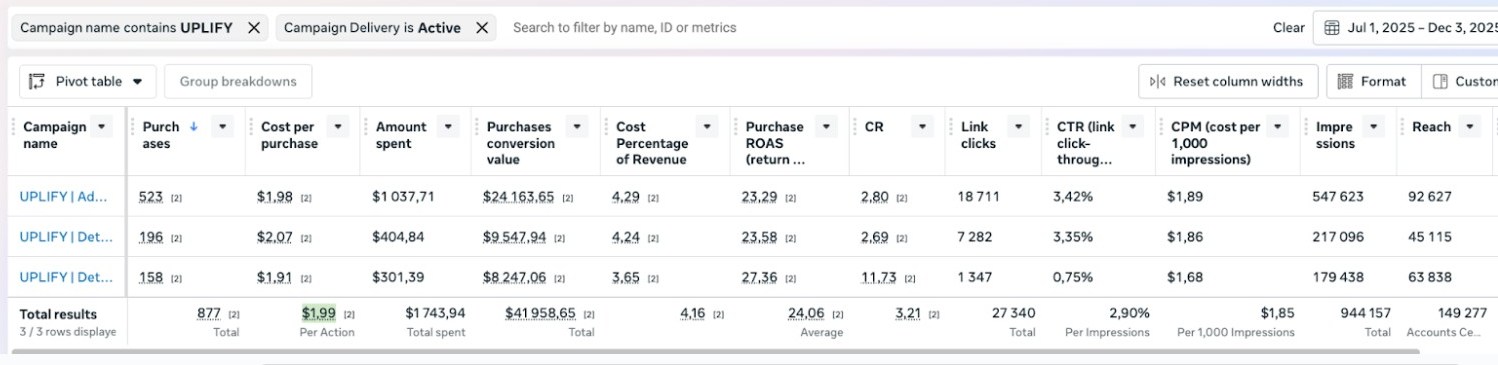
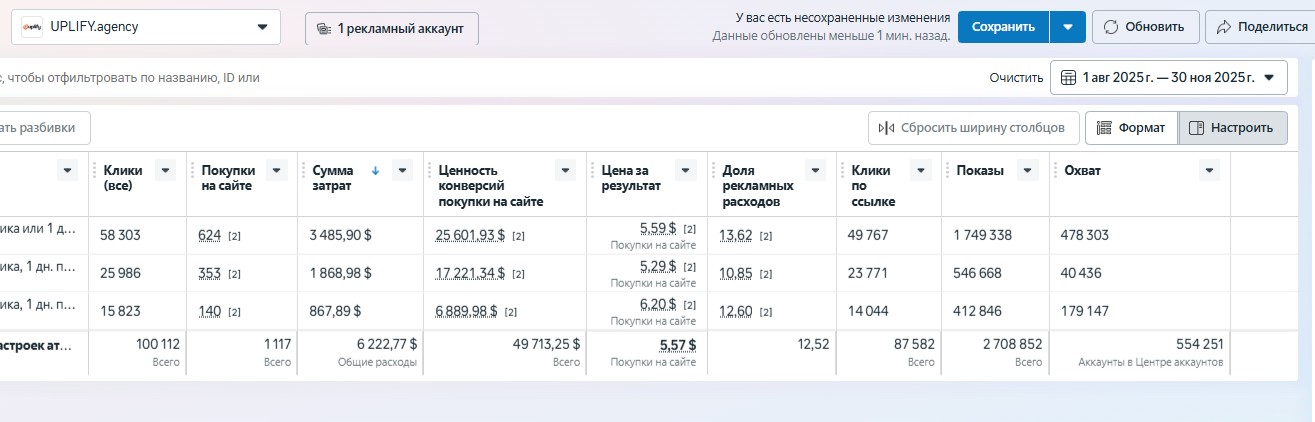
We don't run cases without proof. Here are two clients we've managed on Meta Ads — with real screenshots from Meta Ads Manager (click to enlarge). Numbers from the platform, not our slides.
Meta Ads for a board games store. Catalog Sales + Advantage+ Shopping. Full structure rebuild from a chaotic merge to a managed model.
open case →
Scaling Meta Ads for a furniture store without growing CPA. Adv+ structure · Lookalike · Retarget (DPA) tied to KPIs.
open case →Not by store size. By where you are now: Pixel not in place → "Starter". Pixel exists, funnel is chaotic → "Growth". Meta is steady, want Meta + Google in one window → "Omni".
Pixel + CAPI · first campaign · foundation
In Meta, 80% of success is the right Pixel and events (Purchase · Lead · InitCheckout). Without them the algorithm fires blind. We start from the foundation: Pixel + Conversions API via GTM, 1 campaign with a clear goal, 30 days of management.
Drill-down to creative · EMQ monitoring · funnel
Meta loves structure: Prospecting → Retargeting → Lookalike. In the cabinet — drill-down Campaign → Adset → Ad with a creative thumbnail and KPIs per item. Pixel + CAPI monitoring with EMQ score (0–10): you see daily how many events are lost and whether browser/server-side match. 2–3 creatives per month from our team — with Hook Rate / Thumb-stop analysis.
Meta QA evaluator · AI creative scoring · Meta + Google together
Your problem isn't "how to launch Meta" — it's "how much does Meta add when Google runs alongside?". A single picture: Meta + Google + GA4 + Search Console + Clarity in one cabinet. Meta QA evaluator (analog to our PMax QA): Pixel/CAPI parity · event coverage · catch-all · Advantage+ placements — automated daily. AI scores creative copy (hook · CTA · clarity), monitors Custom Audiences with staleness alerts, drafts ready-to-send client text in one click.
Definitions of the main terms used on this page. If something is unfamiliar — look here.
iOS 14.5+ requires user consent for tracking (App Tracking Transparency), Safari ITP blocks third-party cookies, ad blockers strip JavaScript events. That's 30–40% of browser events lost. The Meta algorithm learns on incomplete data and optimizes for the wrong people. The fix — Conversions API: a server-side event next to Pixel.
CAPI is a server-side event your site/backend sends directly to Meta, bypassing the browser. We set up CAPI via GTM Server-side or directly from the backend. We send the same events as Pixel (Purchase, Lead, InitiateCheckout) + pass an Event ID for deduplication. We verify Event Match Quality (EMQ) — should be ≥ 7/10.
EMQ is a 0–10 score Meta gives based on how many matching parameters are passed (email, phone, IP, user_agent, client ID). The higher the EMQ, the more accurately Meta can attribute conversions and train the algorithm. Minimum target — 7/10. Below 6 — alert.
Six deterministic checks run automatically every day: (1) Pixel/CAPI parity — do browser and server-side events match; (2) event coverage — Purchase / Lead / InitCheckout / AddToCart configured; (3) funnel structure — is Retargeting separated; (4) catch-all adsets — broad audiences eating budget; (5) Advantage+ placements — placements not manually limited; (6) budget strategy — budget not "stuck" on weak adsets.
The client sees not just the aggregate "Meta: ROAS 5×", but a path inward: in Campaign you pick an Adset, in Adset — a specific Ad with a creative thumbnail. Each level has its own KPIs (CTR, CPA, Hook Rate, Thumb-stop). So you see which targeting + which creative is working — not "something somewhere is selling".
Technical minimum — $8–$10/day. Comfortable corridor — from $500/month. Smaller budgets mean slower algorithm learning and less data for optimization. Starter works at smaller budgets too, but we flag the limitations up front.
Technical launch — 3–5 business days. First conversions — 3–7 days. ROAS stabilization — 2–4 weeks of algorithm learning. Objective conclusions — 60 days. Month one is a data-collection phase, not "burn budget and get 10× ROAS".
Catalog Sales — a Meta campaign type where the algorithm picks which product from your catalog to show each user. DPA (Dynamic Product Ads) — a format where Meta auto-builds the ad from a product the user viewed (retargeting mechanic). Works only if Commerce Manager has a clean product feed with prices/availability.
Hook Rate — % of viewers who watch the first 3 seconds of the video. Thumb-stop — % who stop scrolling and pause. These are decisive metrics for video creatives in Reels/Stories. Bad metrics → Meta shows your video less, CPM rises. We measure them by hand during monthly tests.
For a quality Lookalike — minimum 100 Purchase events in the source audience (for small niches — 100 Leads or Add-to-Cart). Ideal — 500+ for a stable LAL. Meta searches for similar 1%/2%/3% of the country's population. You can also build LAL from a customer base (upload email/phone) — often the best result.
We plan creatives (angle, message, hook, CTA, format) and write copy variants. AI helps score copy on hook strength. Filming and editing are separate — not included in packages, but we'll point you to vetted producers. In Growth — 2–3 copy variants per month; in Omni — 8–12 per quarter with A/B planning.
It's all yours: Business Manager, Pixel, CAPI integration, Custom Audiences, Lookalikes, creatives, feed, history. We hand over access and documentation. The client cabinet runs in read-only for 90 days — export reports if needed. No locks.
Describe the task in 2-3 sentences. We'll reply the same business day. We'll look at the accounts, show you where you're growing — and where you're leaking. Free. No commitment.
Form or Telegram. We reply within the business day.
30 min intro — whichever you prefer: phone, Telegram, Viber or email.
30/60/90-day growth roadmap and a fitting engagement package — free.