How does UPLIFY get 2400% ROAS from Meta Ads on a $1,743 budget?

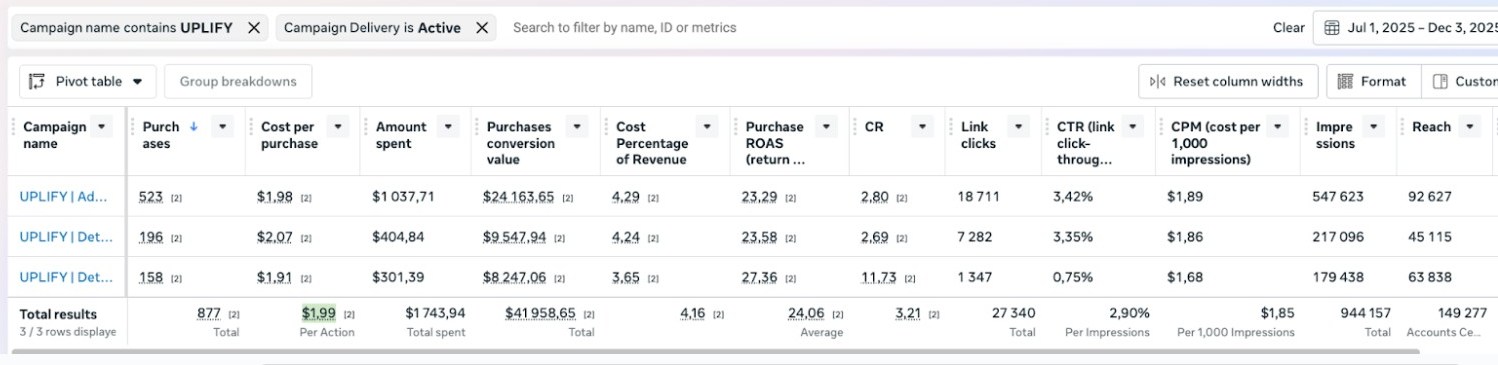
UPLIFY rebuilt the Meta Ads account of a Ukrainian board-games online store: $1,743 ad spend produced $41,958 in revenue (ROAS 2400% / ×24.06), 877 purchases at a $1.99 CPA over the July–December window. Approach: Pixel + CAPI fix → Catalog Sales (DPA) base → audience × offer × product testing in sprints → scaling on winners.

Meta AdsCatalog SalesAdvantage+ROASFacebook AdsDPADynamic Product AdsConversions APICAPIROAS 2400%board games e-commerceUPLIFY case studyUkraineQ139583119
← cases · Meta · board games
CASE · META ADS JUL 1 — DEC 3 ● active

2400% return
on ad spend for a
board-games online store.

$1,743 ad budget → $41,958 in revenue from Meta Ads. Not a one-off lucky shot — a controlled model: test → optimize → scale.

ROAS
2400%
× 24.06 return
Revenue
$41 958
Meta Ads · GA4 verified
Budget
$1 743
total for the period
Purchases · CPA
877
$1.99 per conversion
client
Board-games online store
vertical
E-commerce · hobby / leisure
reporting period
July 1 — December 3
channel
Meta Ads · Catalog Sales (DPA)
model
test → optimize → scale
status
still working together
/ tl;dr

case in 5 lines.

meta-ads-board-games.json ● active
[01]before::Client had been running ads — spend was rising, payback was not, the channel was deemed unprofitable
[02]budget::$1,743 — total ad budget for the reporting period
[03]revenue::$41,958 revenue · ROAS 2400% · 877 purchases
[04]cpa::CPA = $1.99 · campaign #1 = active
[05]model::data → catalog → tests → scaling · DPA base + creative tests
$_
/ 01 · context and goal

from budget burn to systematic payback.

problem

Budget burn

The client had been running Meta Ads, but it was not working: spend kept rising, while there was no clear picture of payback. The channel was considered unprofitable.

goal

Systematic payback

Fully rebuild the ad strategy. Prove Meta as a profitable channel and scale sales without losing efficiency (ROAS).

/ 02 · what we did · scroll

framework: data → catalog → tests → scaling.

STEP · 01AUDIT + STRATEGY

Audit and strategy

We checked the data infrastructure and laid the foundation for scaling.

  • Audited Pixel + Conversions API, events and data quality (purchase/value, deduplication, attribution)
  • Segmented the catalog into priority product groups (hits / margin-rich / seasonal)
  • Built the offer matrix: what to sell and to whom (audiences × triggers × price/value)
  • Designed the structure: Catalog Sales (DPA) as the base + creative tests for promotions
  • Defined test KPIs: CPA / ROAS / AOV + daily checkpoints
PixelCAPICatalogStructure
STEP · 02TESTING · SPRINTS

Testing in sprints

Audience → Product → Offer combinations were tested in a clear matrix, not chaotic launches.

  • Launched catalog campaigns with the right product sets
  • Tested audiences: Broad / interests / lookalike / retargeting (in batches, not chaotically)
  • Tested Audience → Product → Offer combinations (what actually hooks)
  • Cut unprofitable combinations and kept the winners by the numbers
  • Set rules: when to scale, when to rebuild a test
BroadLaLRetargetDPA
STEP · 03SCALING

Scaling

Increased budgets on the winners without efficiency decay.

  • Raised budgets on winners (without spilling onto weak combinations)
  • Split campaigns by role: cold traffic / retargeting / DPA
  • Tuned optimization toward purchase (not "cheap traffic")
  • Enabled dynamic remarketing (DPA) with view/cart logic
  • Held stability through frequency, placements, and traffic-quality control
ScaleDPA retargetFrequency control
/ 03 · results

the systematic approach delivered a steady ROAS of 2400%.

By using a systematic approach we reached a stable ROAS of 2400% and meaningfully reduced customer acquisition cost.

Reporting period
July 1 — December 3
Spend
$1,743
Revenue
$41,958
ROAS
2400% · ×24.06
Purchases
877
CPA
$1.99
/ proof from the dashboard
Meta Ads dashboard screenshot · ROAS 24× · spend $1,743 · revenue $41,958
$41 958
revenue from a $1,743 budget · ROAS 2400%
we continue the partnership and keep scaling
/ 04 · frequently asked questions

setting up Meta Ads.

01What exactly do you set up in Meta Ads, end-to-end?

Campaign structure, events / Pixel + CAPI (where possible), audiences, e-commerce catalogs, UTM tags, baseline analytics, and optimization rules.

02What do you need from us to start?

Access to the ad account and the website (or GTM), basic unit economics (AOV, margin), top products / categories, and a clear goal (sales / leads).

03When do the first results show up?

First signals — after tests (typically 7–14 days). Stabilization and scaling — 2–6 weeks, depending on niche, season, and data volume.

04How do you decide whether ads are paying off?

We track sales / leads, cost per result, and traffic quality. For e-commerce we cross-check with store / CRM data — not just dashboard numbers.

05Why does "just launching ads" often fail?

Without correct events, campaign structure, and systematic tests, the algorithm optimizes the wrong thing: traffic comes in, results don't. We build a controlled process with metric-level oversight.

06How do you work with creatives — what do you show audiences?

We start from the product feed / catalog: showing audiences specific store products. Banner / video formats are used for promotions and seasonal campaigns. Creative production is a separate line item.

07What matters more — budget or site / offer quality?

Both. You can pour budget in, but without a solid product page, terms, and trust signals, it burns. Our job is to make traffic convert.

08Which typical mistakes kill results?

Broken tracking (events / Pixel / CAPI), chaotic campaign structure, no test plan, weak product pages and offers, ignoring economics (margin / AOV).

09Do you guarantee specific numbers (ROAS / sales)?

Honestly — no, not without a test: niche, season, AOV, margin, and product all matter. What we guarantee is a transparent process and clear reporting.

10What do I get after the setup?

A working system: account structure, accurate events / analytics, set-up catalog / feed (for e-commerce), a set of tested hypotheses, and a clear scaling plan.

Get in touch

start with a
growth audit.

Describe the task in 2-3 sentences. We reply within the same business day. We will look at your accounts and show where you are growing and where you are losing money. Free. No commitment.

  1. 01/03
    Request

    Form or Telegram. We reply within the business day.

  2. 02/03
    Call or message · 24h

    30 min intro — your choice of channel: phone, Telegram, email.

  3. 03/03
    Free audit

    Growth-points map for 30/60/90 days, scope of work — free.

add details (optional)

Reply within the business day · no spam · no commitment

skip →